You can find all my publications on InspireHEP.
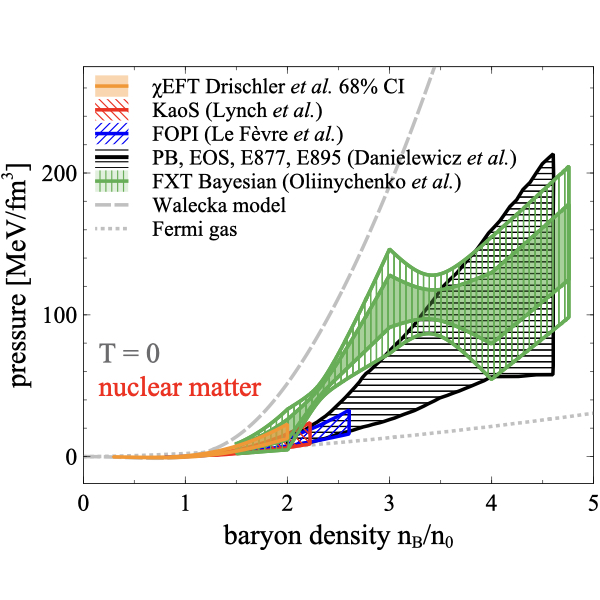
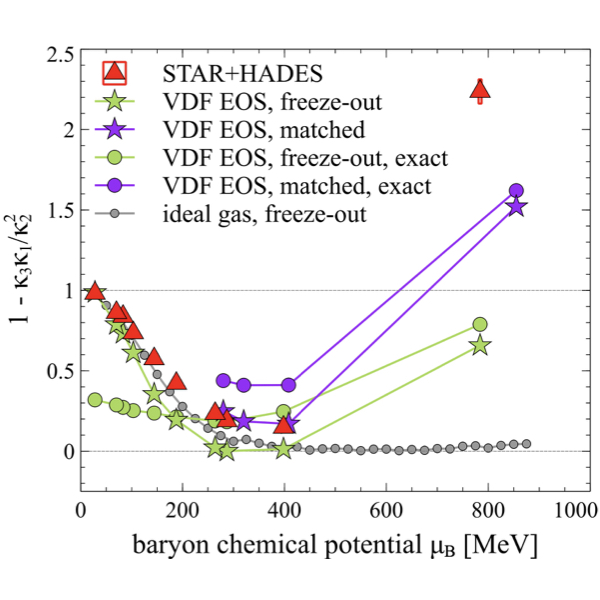
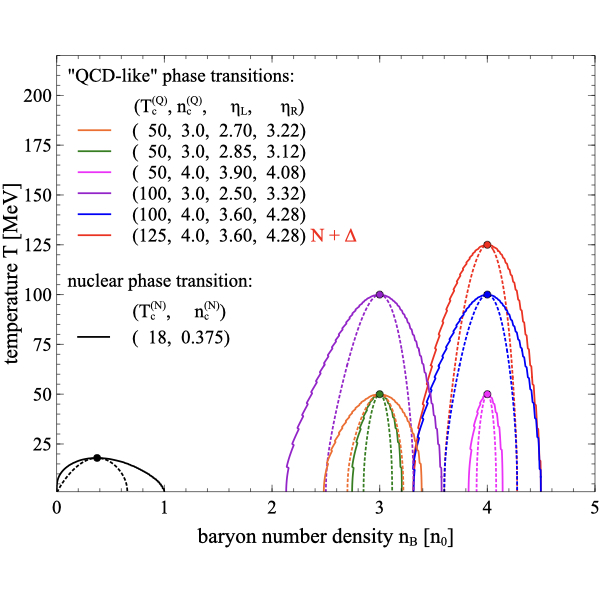
My research focuses on uncovering the properties of dense, strongly-interacting matter. These properties can be summarized in the QCD equation of state (EOS). The EOS is key for describing behavior of nuclear matter in extreme environments, such as supernovae, neutron stars and their mergers, and relativistic collisions of heavy nuclei, and it can address the following open questions:
- Does QCD matter undergo a first-order phase transition at finite baryon density?
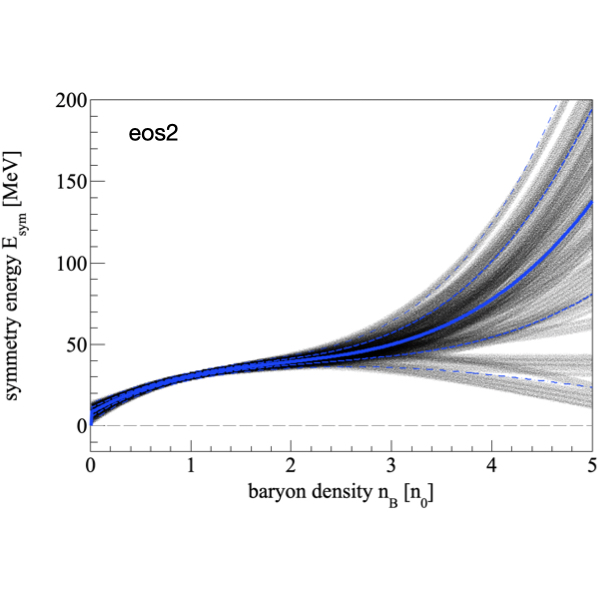
- How does the isospin dependence of the EOS evolve with density and temperature?
- How do nuclear matter degrees of freedom and their properties change as the thermodynamic variables are varied?
I study these questions by using dynamical simulations of relativistic heavy-ion collisions, developing flexible EOS meta-models, and performing wide-ranging comparisons to experimental data. In my work, I use both high-performance computing and machine learning (ML) methods to enable these analyses.
Currently, my group is working on the following projects:
-
Observable discovery with AI/ML (part of Genesis Mission)
As part of the inaugural cohort for the U.S. Department of Energy's Genesis Mission, our team explores using machine learning (ML) to discover new EOS observables in heavy-ion collisions. In particular, we are looking for observables that, while sensitive to the EOS, are at the same time insensitive to other, often poorly-constrained inputs to the collision dynamics (such as, e.g., the in-medium modification of the cross sections). Successful completion of this project will not only help to put robust constraints on the EOS, but open a new era of using novel approaches and architectures to analyzing data and/or emulating events.
This ongoing work is pursued together with MSU/FRIB graduate students Daniel Barr and Joshua Belieu, and collaborators from Duke University (Steffen Bass, Lance Lampert, Andrea Kirschner), UC Davis (Daniel Cebra, Mathias Labonte, Kate Matsubayashi, Andrea Pellot Jimenez), and LLNL (Indra Chakraborty, Ron Soltz).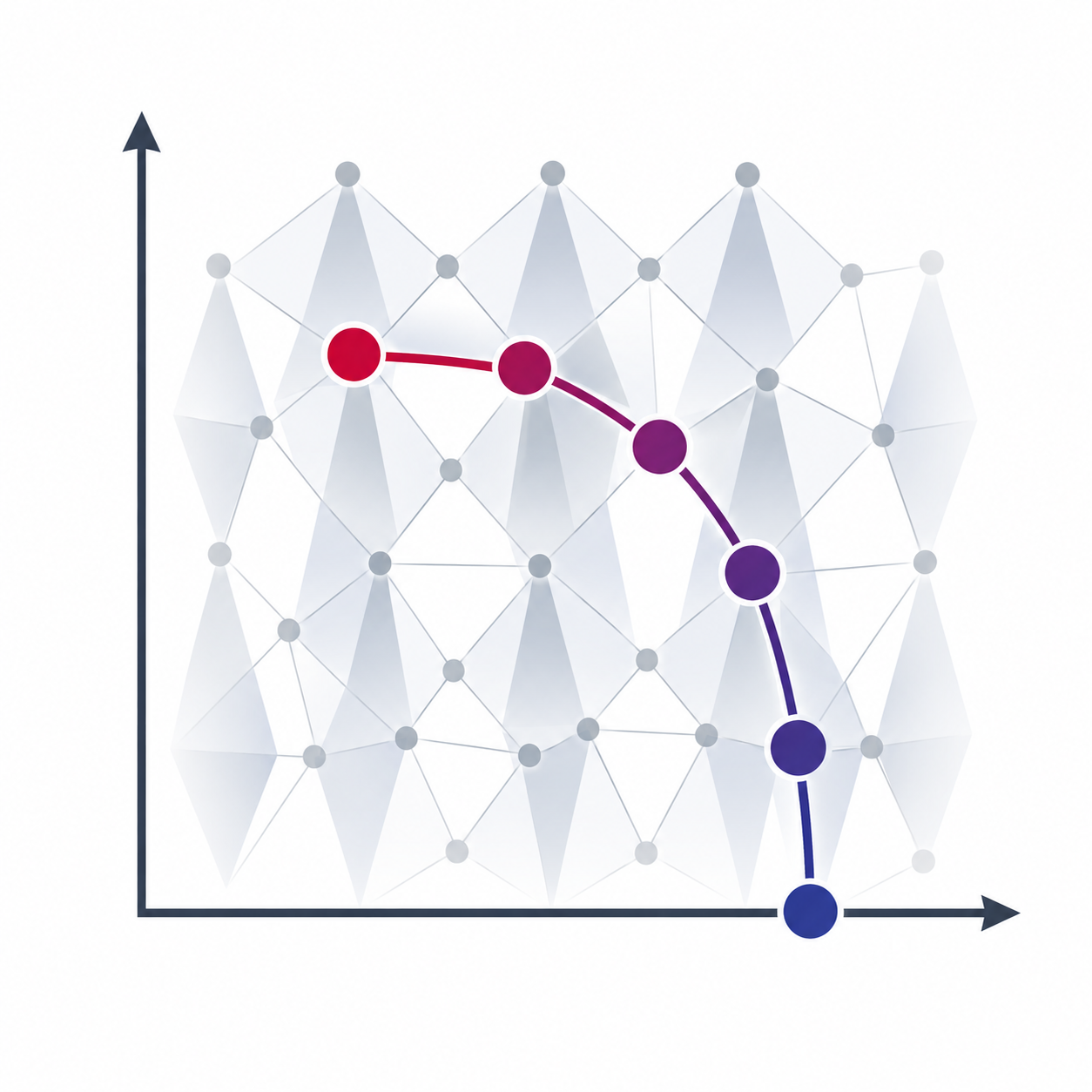
-
Modeling the momentum dependence of the nuclear interaction
Momentum dependence is a crucial component of the nuclear interaction, measured in experiments colliding protons in heavy nuclei, without which the EOS extracted from comparisons of transport simulations to experimental data is strongly biased to exhibit more repulsive behavior. However, modeling the momentum dependence in hadronic transport can be challenging due to the inherent complexity, and thus numerical cost, of the relevant expressions. Because of this, implementations often use drastic simplifying assumptions, which is also the case for the recent implementation of the momentum-dependent potential in the hadronic transport code SMASH. In this project, we aim to restore the expected behavior of the momentum-dependent potentials currently implemented in SMASH, as well as to explore generalization of the approach to full Lorentz-covariance.
This ongoing work is led by MSU/FRIB graduate student Daniel Barr.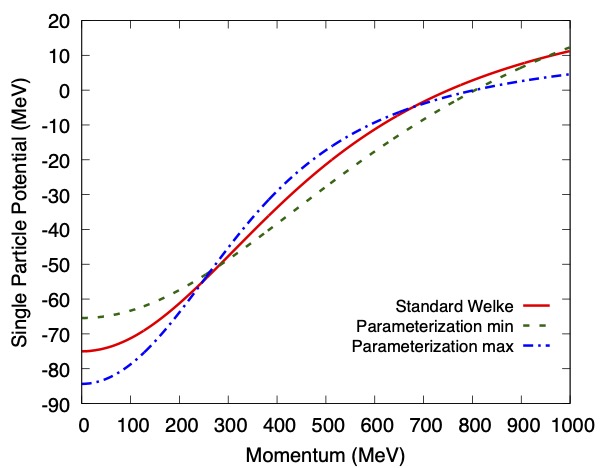
-
Extracting flow observables from detectors with complicated geometries
The collective behavior of matter produced in heavy-ion collisions is sensitive to the dense nuclear matter equation of state. However, traditional flow observables -- whch quantify this behavior -- can be difficult to extract from data collected using detectors with complicated geometries. This is because common approaches of computing flow require establishing the reaction plane of the collision, which can be problematic outside without a full solid angle coverage. In this work, we explore using the cumulant method of extracting flow at very low collision energies, such as those explored at NSCL and FRIB. In particular, we aim to apply the developed method to data collected in NSCL experiments E15190, E14030.
This ongoing work is pursued together with MSU/FRIB graduate student Samuel Brown and his Ph.D. advisor Kyle Brown.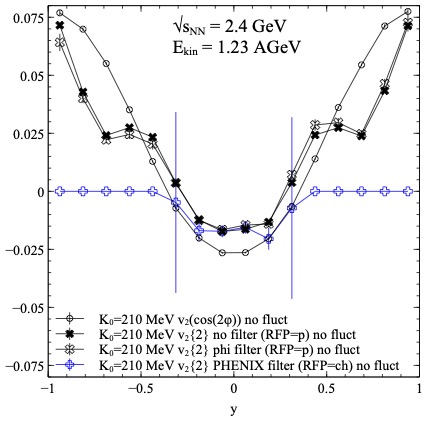
-
Modeling fluctuations in the initial state of heavy-ion collisions
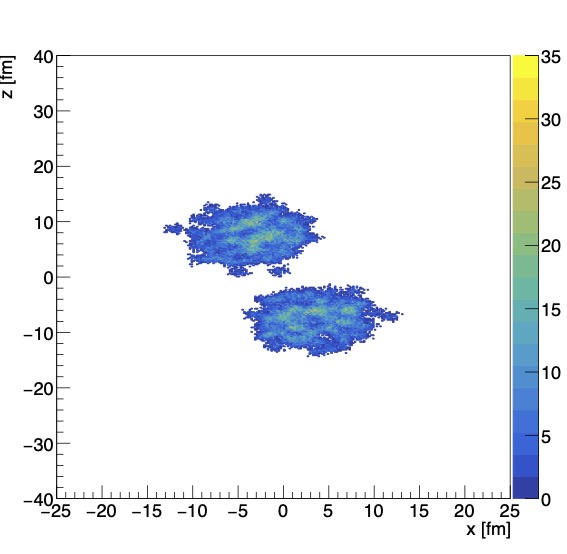
Boltzmann-Uehling-Uhlenbeck (BUU) transport frameworks model the evolution of the system's distribution function \( f(\mathbf{x}, \mathbf{p}) \) with the method of test particles, i.e., by evolving thousands of samples of \( f(\mathbf{x}, \mathbf{p}) \). This oversampling allows one to obtain excellent estimates of the local densities and, therefore, mean-field potentials. However, oversampling can also unphysically suppress density fluctuations related to the finite number of nucleons composing the colliding nuclei. In this project, we implement a practical algorithm to account for these fluctuations in two BUU frameworks: SMASH and DJBUU.
This ongoing work is pursued together with collaborators: Sangyong Jeon (McGill University, Canada) as well as Youngman Kim and and Kyungil Kim (Institute for Basic Science, South Korea).